
What to Know Before Buying a Commercial Water Heater
Commercial water heaters are the backbone of hot water supply for businesses — from restaurants and hotels to hospitals and multi-unit buildings. Choosing the wrong one means cold showers, failed health inspections, or sky-high energy bills.
Here’s a quick comparison of the main types to match your search intent:
| Type | Best For | Efficiency | Key Advantage |
|---|---|---|---|
| Gas Tank | High-volume facilities | Up to 98% thermal | Fast recovery, proven reliability |
| Electric Tank | Moderate demand, indoor use | ~98% thermal | Simple install, no venting needed |
| Tankless (Gas or Electric) | Space-limited or variable demand | Very high | Endless hot water, compact footprint |
| Heat Pump | Facilities with low to moderate demand | Highest (uses ambient heat) | Lowest operating cost |
The right choice depends on your facility size, peak hot water demand, fuel availability, and local regulations — including new DOE energy standards taking effect October 6, 2026.
Major brands like A.O. Smith, Rheem, Lochinvar, and Bradford White all offer strong commercial lineups, but they differ in efficiency, warranty, controls, and support.
This guide breaks it all down so you can make a confident, informed decision.
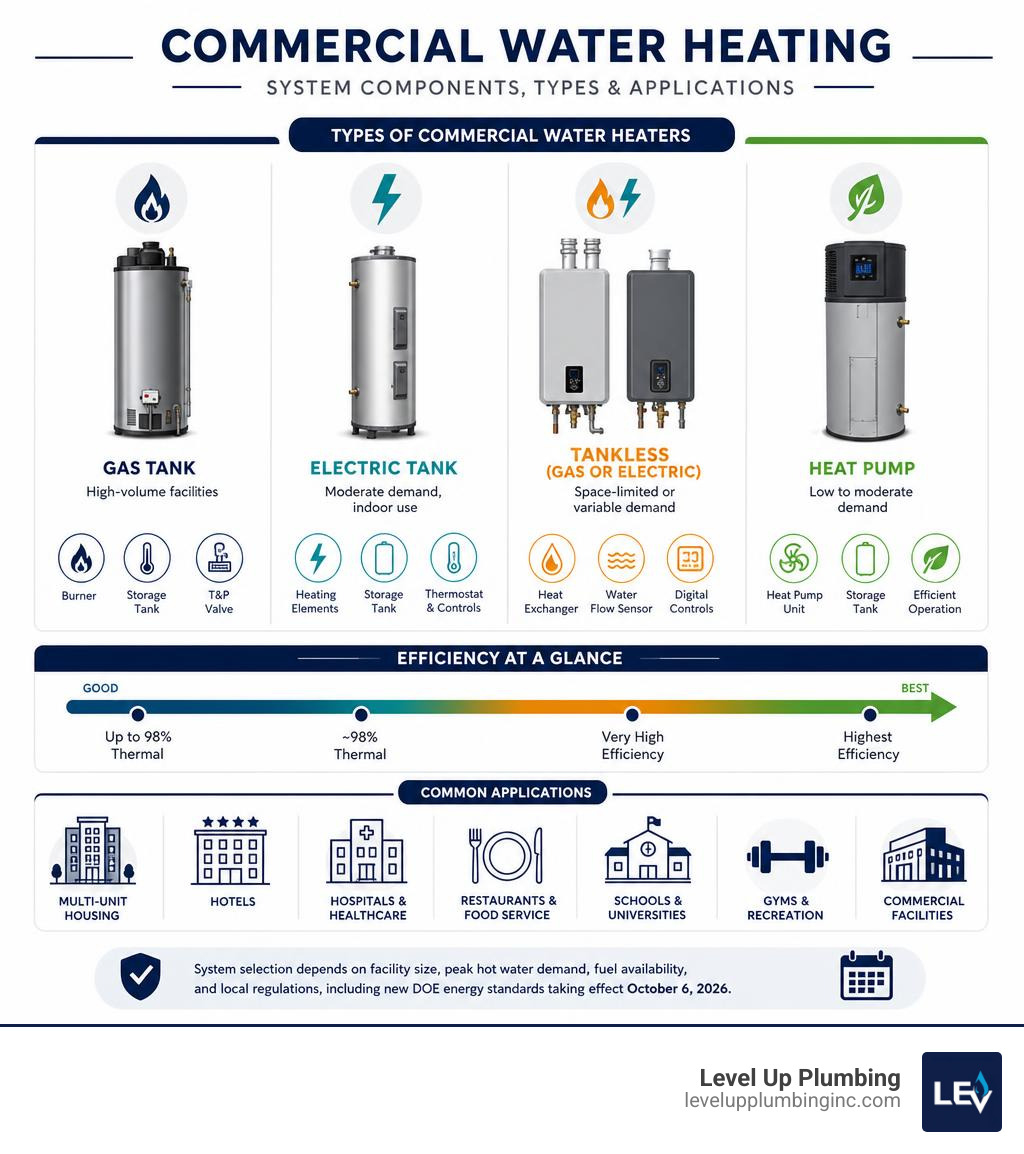
Types of Commercial Water Heaters and Their Applications
Selecting the ideal commercial water heating system isn’t a one-size-fits-all decision. The physical footprint, available utility connections, and daily hot water usage patterns of your business will dictate which system makes the most operational and financial sense.
When you dive into Exploring the World of Water Heaters, you quickly realize how much commercial demands dwarf residential needs. A single commercial dishwasher in a busy Huntington Beach restaurant can consume more hot water in an hour than an entire household uses in a day.
To help you navigate these choices, let’s explore the primary commercial water heater categories, their ideal applications, and how they stack up in high-demand environments.
Commercial Gas Water Heaters
For businesses requiring massive volumes of high-temperature water delivered rapidly, gas-fired commercial water heaters remain the undisputed industry standard. These systems are designed to burn natural gas or liquid propane to heat water quickly and efficiently.
Modern commercial gas water heaters have moved far beyond the simple atmospheric-vent models of the past. Today’s market is dominated by high-efficiency condensing technology. In a condensing system, combustion gases are cooled to the point where the water vapor in the gas condenses, releasing latent heat back into the system. This allows units to achieve incredible thermal efficiency ratings of 95% to 98%.
Many premium gas water heaters also feature modulating burners. Instead of simply turning fully “on” or fully “off,” a modulating burner adjusts its fuel input dynamically based on real-time demand. This prevents short-cycling, reduces wear and tear on components, and slashes energy bills.
Two standout examples of this technology include:
- A.O. Smith XP Plus PWH-1250NP: This circulating gas water heater delivers up to 98% thermal efficiency with a maximum input of 1,250,000 BTUs. It features an advanced fully modulating system with up to a 10:1 turndown ratio, making it a powerhouse for large-scale commercial and industrial applications.
- Lochinvar Shield SWR400N: Boasting a 117-gallon nominal capacity and 95% thermal efficiency, this model uses a condensing stainless steel heat exchanger. Its high-velocity water flow design prevents lime scale buildup, making it exceptionally reliable in areas with hard water.
Commercial Electric Water Heaters
While gas is highly favored for its rapid recovery rates, commercial electric water heaters are the perfect solution for facilities where venting is difficult, gas lines are unavailable, or indoor space is tightly confined.
Heavy-duty electric water heaters use high-grade electric heating elements immersed directly in the water tank. Because there is no combustion process, these units require zero venting, have no risk of carbon monoxide leaks, and can be installed in tight closets or utility rooms with zero clearance to combustible materials.
To withstand the harsh environment of constant heating cycles, manufacturers equip these systems with advanced corrosion-resistant components. High-quality incoloy-sheathed heating elements are standard in commercial-grade units to protect against oxidation, mineral scaling, and dry-firing.
If you are looking at heavy-duty electric specifications, several models lead the market:
- Rheem Heavy Duty Electric Specifications: Rheem’s commercial electric line includes 50, 85, and 120-gallon capacities with inputs ranging from 6 kW up to 54 kW. These units feature System Sentinel diagnostic panels to monitor element status and Lifeguard stainless steel screw-in elements to resist burnout.
- Lochinvar LHC-50 P12: A standard 50-gallon commercial electric model designed for hot water supply or booster sanitization in commercial kitchens. It utilizes three heavy-duty incoloy elements and dual commercial-grade anode rods for maximum tank protection.
- Lochinvar LCA-120: A heavy-duty 120-gallon ASME-certified tank designed for maximum-demand hot water supply. It supports power inputs up to 54,000 watts and includes advanced electronic controls with night setback capabilities to reduce energy consumption during off-hours.
Over time, even the toughest elements can wear out. If your system is struggling to reach temperature, consult The Ultimate Hot Water Heater Element Replacement Guide to understand how these critical components are serviced and replaced.
Tankless and Heat Pump Systems
For businesses looking to optimize space and maximize energy efficiency, tankless and heat pump technologies represent the cutting edge of commercial water heating.
Commercial tankless water heaters heat water only on demand. When a faucet or commercial dishwasher is turned on, cold water flows through a high-output heat exchanger, which instantly heats the water to the desired setpoint. This eliminates standby heat loss—the energy wasted keeping a large tank of water hot when nobody is using it.
Furthermore, tankless systems are incredibly compact. They are typically wall-mounted, freeing up valuable floor space in cramped commercial kitchens or utility rooms. For higher demands, multiple tankless units can be manifolded together in a “rack system,” allowing them to operate as a single cohesive unit that scales up or down based on real-time usage.
If you are considering making the switch, check out this Limited Time Save Up to $1900 on a New Tankless Water Heater offer to see how affordable upgrading your business’s infrastructure can be. For businesses in our local service areas, scheduling a professional Tankless Water Heater Installation in Garden Grove ensures that your new unit is sized perfectly and installed in full compliance with local building codes.
Commercial heat pump water heaters, on the other hand, represent the ultimate in green technology. Instead of generating heat directly through combustion or electrical resistance, they use electricity to transfer heat from the surrounding air or water source into the water tank. While their recovery times are slower than gas units, their operating costs are unmatched, making them incredibly attractive for facilities looking to slash carbon footprints and utility bills.
Sizing and Capacity Guidelines for Commercial Facilities
Sizing a commercial water heating system is a precise science. If you undersize the system, your business will run out of hot water during peak times, leading to unhappy customers, disrupted operations, and potential health code violations. Oversize it, and you’ll pay unnecessary upfront equipment costs and waste money heating water you don’t need.

To size a commercial system accurately, we look at several critical metrics:
- Peak Hourly Demand (GPH): This is the maximum volume of hot water (in gallons) your facility uses during its busiest single hour of operation. For example, a restaurant’s peak hour might occur during the Friday night dinner rush when the pre-rinse sink, commercial dishwasher, and handwashing stations are all running simultaneously.
- Temperature Rise: This is the difference between the incoming cold-water temperature and your desired hot-water temperature. In Southern California, incoming groundwater averages around 60°F. If your commercial dishwasher requires sanitizing hot water at 180°F, your system must achieve a temperature rise of 120°F.
- Fixture Units: We calculate the total number and types of hot-water fixtures (sinks, showers, dishwashers, washing machines) in your facility to estimate cumulative demand.
- Storage vs. Recovery: Commercial systems balance storage capacity (the size of the tank) with recovery rate (how quickly the heater can heat cold water). A system with a small tank but a very high recovery rate (like a tankless rack system) can perform just as well as a massive storage tank with a slower recovery rate.
To learn more about how these factors influence your equipment choices, read our guide on Water Heaters Which is Best for Me.
Efficiency Ratings, Regulations, and Rebates
In the commercial sector, energy efficiency isn’t just about environmental stewardship—it directly impacts your bottom line. Since commercial water heaters run almost continuously, even a minor boost in efficiency can translate to thousands of dollars saved annually.
When comparing commercial water heaters, look for these key metrics:
- Thermal Efficiency (TE): The percentage of energy from the fuel source that is successfully transferred to the water. High-efficiency condensing gas systems boast up to 98% TE.
- Standby Loss: The percentage of heat lost from a storage tank during periods of non-use. High-quality insulation and advanced electronic controls (like night setbacks) help minimize this loss.
Regulatory Compliance and the 2026 Shift
Commercial building codes and environmental regulations are tightening rapidly. Of note are the new Department of Energy (DOE) energy conservation standards taking effect October 6, 2026. These standards mandate higher minimum efficiency ratings for commercial water heating equipment, pushing the industry heavily toward condensing gas technology and high-efficiency electric systems.
Additionally, businesses operating in Orange County, CA, must comply with strict South Coast Air Quality Management District (SCAQMD) rules regarding nitrogen oxide (NOx) emissions. Many commercial gas units must be certified as Ultra-Low NOx (less than 20 ppm) to be legally installed in our region.
Rebates and Tax Credits
Upgrading to high-efficiency equipment often qualifies your business for substantial financial incentives. Federal tax credits, state energy programs, and local utility rebates can offset a significant portion of your installation costs. You can Maximize Your Savings with Energy Star Water Heater Tax Credits by selecting qualifying high-efficiency models and ensuring your paperwork is filed correctly.
Installation, Maintenance, and Warranty Considerations
Installing a commercial water heater requires specialized plumbing, electrical, and venting expertise. Unlike residential units, commercial systems often handle higher water pressures, complex electrical configurations (such as 3-phase power at 208V, 240V, or 480V), and strict venting codes.
For gas-powered condensing units, proper venting is critical. These systems produce acidic condensate that must be safely drained through a neutralizing kit before entering your facility’s plumbing system. The exhaust must be vented using approved materials like PVC, CPVC, or specialized stainless steel, depending on the manufacturer’s specifications and local building codes.
To ensure your system is hooked up safely and correctly, check out our guide on How to Connect a Hot Water Heater Step-by-Step.
Preventative Maintenance: The Key to Longevity
Commercial water heaters are major capital investments. To protect that investment, a structured preventative maintenance schedule is essential. Without regular care, mineral scale will accumulate on heating elements and heat exchangers, drastically reducing efficiency and leading to premature tank failure.
An effective maintenance plan should include:
- Flushing the Tank: Annually draining and flushing the storage tank to remove sediment and mineral buildup.
- Inspecting Anode Rods: Checking sacrificial and powered anode rods that protect the steel tank from rusting.
- Testing Safety Valves: Testing temperature and pressure (T&P) relief valves to ensure they function in an emergency.
- Burner and Vent Inspection: For gas units, cleaning the burner assembly and checking venting paths for blockages.
We cannot overstate The Importance of Annual Maintenance to Your Water Heater. Regular service keeps your system running at peak efficiency, prevents costly emergency business shutdowns, and keeps your manufacturer’s warranty valid.
Frequently Asked Questions
How do I know if my business needs a tankless or tank system?
The choice depends on your daily hot water demand patterns and physical space. Tank systems are excellent for businesses with massive, sudden spikes in hot water usage (like a gym with multiple showers running at once). Tankless systems are ideal for businesses with space constraints or continuous, predictable demand (like restaurants and salons). If you are tired of running out of hot water during peak operational hours, read how to Stop Running Out of Hot Water with Level Up Plumbing.
What are the new DOE energy conservation standards for 2026?
Beginning October 6, 2026, new DOE standards will mandate higher minimum energy efficiency levels for newly manufactured commercial water heaters. This shift aims to phase out older, atmospheric-vent commercial gas units in favor of high-efficiency condensing models. Any equipment installed after this date must meet these rigorous compliance standards.
How long do commercial water heating units typically last?
On average, a well-maintained commercial tank water heater lasts between 6 to 12 years, while commercial tankless water heaters can last up to 20 years. The primary factor influencing this lifespan is preventative maintenance; systems in hard-water areas like Orange County CA that are not regularly flushed will fail much faster than those on a routine maintenance plan.
Conclusion
A reliable commercial water heater is vital to the daily success of your business. Whether you run a bustling restaurant in Cypress CA, a medical facility in Garden Grove CA, or a commercial building in Huntington Beach CA, you need hot water you can count on.
At Level Up Plumbing, we bring 21+ years of local plumbing expertise and award-winning customer service to every commercial project. As a proud, woman-owned local business, we understand the unique plumbing challenges faced by Southern California business owners. From sizing and selecting the perfect energy-efficient system to complete installation and routine preventative maintenance, our team of licensed experts is here to support you at every phase.
Don’t wait for your hot water to fail. Schedule Commercial Water Heaters Service in Huntington Beach with us today, and let us help you level up your business’s efficiency and reliability!