
What You Need to Know About Hot Water Heater Connections
Understanding hot water heater connections is the first step to a safe, leak-free installation. Here’s a quick overview of the main connection types:
| Connection Type | Material | Best For |
|---|---|---|
| Cold water inlet | Copper, PEX, or flexible stainless | Bringing cold water into the tank |
| Hot water outlet | Copper, PEX, or flexible stainless | Delivering hot water to your home |
| T&P relief valve | Copper, PEX, or CPVC discharge pipe | Safety pressure release |
| Gas supply line | Flexible corrugated stainless | Gas-powered units only |
| Electrical connections | Hardwired or cord with GFCI | Electric units only |
| Shutoff valve | Brass ball or gate valve | Cold water line near the unit |
A typical residential water heater lasts 10 to 15 years. When it’s time to replace yours — or you’re dealing with a leak or a new install — getting the plumbing connections right is critical.
Get it wrong and you risk water damage, scalding, or worse.
Water at just 125°F (52°C) can cause severe burns in under two minutes. That’s why every connection — from the supply lines to the temperature and pressure (T&P) relief valve — needs to be done correctly and to code.
Whether you’re a hands-on homeowner in Southern California or just trying to understand what your plumber will do, this guide walks you through every connection, step by step.
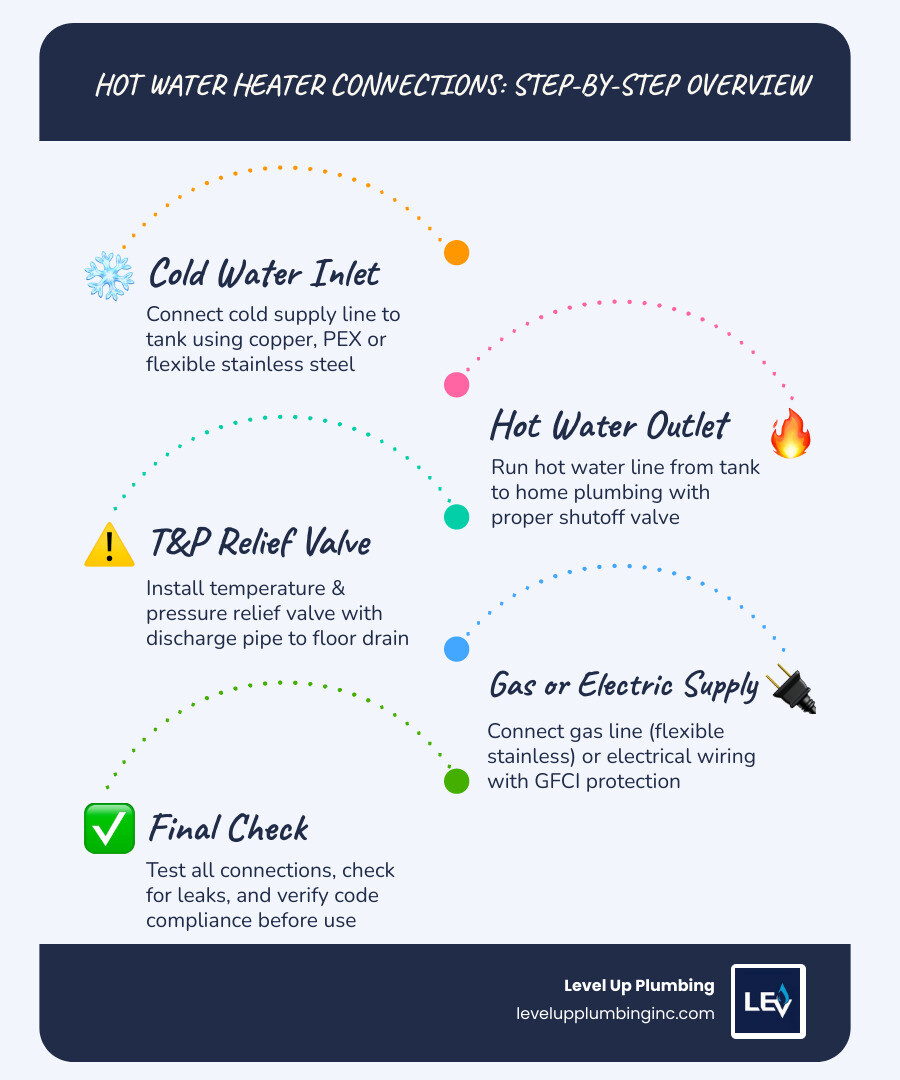
Choosing the Right Hot Water Heater Connections
Selecting the proper components for your hot water heater connections is just as important as the installation process itself. Using incompatible materials or incorrect sizes can lead to premature corrosion, structural leaks, or system failure.
To ensure your system runs smoothly, you first need to evaluate your home’s existing plumbing setup and choose a compatible water heater. If you are still deciding on the ideal system for your home, you can learn more about choosing the right water heater type to match your family’s daily hot water demands.

Once you have your unit, you must select the right supply lines. Below is a direct comparison of the most common materials used for water heater connectors:
| Material | Pros | Cons | Best Used For |
|---|---|---|---|
| Rigid Copper | Extremely durable, professional look, handles high heat and pressure, code-compliant everywhere. | Requires soldering (sweating) skills and special tools; rigid and unforgiving to align. | Permanent, high-end installations and direct connections. |
| Flexible Stainless Steel | Highly corrosion-resistant, flexible, easy to install in tight spaces, no soldering required. | More expensive than copper; can restrict flow slightly if bent too sharply. | DIY installations, seismic zones like Orange County, and tight closets. |
| PEX (Cross-linked Polyethylene) | Flexible, easy to cut, resistant to scale buildup, highly affordable. | Cannot connect directly to the top of the water heater (requires a 18-inch metal buffer pipe). | Modern home repipes and runs leading up to the heater closet. |
Types of Hot Water Heater Connections
- Rigid Copper Pipes: The gold standard of traditional plumbing. Copper is incredibly reliable and can withstand high temperatures without degrading. However, installing rigid copper requires soldering torch proficiency, making it a challenging choice for amateur DIYers.
- Flexible Stainless Steel Connectors: These corrugated metal hoses are a favorite in modern plumbing. They allow for slight misalignments between your home’s pipes and the water heater inlets, making installation much easier.
- Flexible Braided Connectors: Similar to corrugated stainless steel, these have a braided outer mesh. They are highly flexible and usually rely on compression fittings, eliminating the need for soldering.
- PEX Connectors: PEX is incredibly popular due to its ease of use and flexibility. However, plumbing codes require that you do not connect PEX directly to the water heater inlet or outlet. You must install at least 18 inches of copper or metallic pipe first to protect the PEX from the intense radiant heat rising from the unit.
- Dielectric Unions: These are specialized fittings designed to join two different metals—typically the copper supply line and the steel water heater tank connections. They contain an internal plastic sleeve that prevents the metals from touching, stopping galvanic corrosion in its tracks.
Sizing and Material Compatibility
Most residential water heaters feature 3/4-inch NPT (National Pipe Thread) male connections on the top of the tank. To ensure a secure fit, your supply lines must match this size. If your home has older 1/2-inch pipes, you will need to use reducing adapters to bridge the gap safely.
In addition to sizing, local building codes dictate exactly how these connections must be configured. For example, homes in Southern California must adhere to strict seismic and safety standards. If you reside in Cypress, CA, you must follow the official [PDF] Residential Water Heater Installations – City of Cypress guidelines. These rules require proper strapping to resist earthquake movement, the use of a metal drain pan under the unit, and specific thermal expansion tank installations if you are on a closed-loop water system.
Essential Tools and Materials for Installation
Before you begin assembling your hot water heater connections, gather all the necessary tools and materials. Having everything on hand prevents mid-project trips to the hardware store while your home’s main water supply is shut off!
- Full-Flow Shutoff Valves: A dedicated brass ball valve must be installed on the cold water inlet side. This allows you to isolate the water heater for future maintenance without shutting off water to the entire house.
- Teflon Tape (Plumber’s Tape) or Pipe Joint Compound: Used to seal threaded connections and prevent microscopic water leaks.
- Pipe Cutters: Essential for clean, square cuts on copper or PEX tubing.
- Pipe Wrenches and Channel Locks: You will need two wrenches—one to hold the water heater’s built-in nipples steady, and another to tighten the supply line fittings.
- Metal Drain Pan: Essential for catching slow leaks and protecting your home from water damage. According to local codes, the pan must be at least two inches wider than the diameter of your water heater.
- Thermostatic Mixing Valves: These valves mix cold water into the hot water stream right as it leaves the heater, allowing you to store water at a bacteria-killing 140°F inside the tank while safely delivering a non-scalding 120°F to your home’s faucets.
How to Install Your Water Heater Lines
Plumbing can be a highly rewarding DIY project, but it requires patience and a strict adherence to safety protocols.

Step-by-Step Guide to Installing Hot Water Heater Connections
Before turning a single wrench, always prioritize safety. Shut off the electrical breaker powering the unit (for electric heaters) or turn the gas control valve to the “Off” position (for gas heaters). Shut off the main water valve to your home, and drain the existing tank completely by attaching a garden hose to the drain valve at the bottom of the unit.
Once the old unit is removed and the new one is positioned in its drain pan, follow these steps to connect your new lines:
- Prepare the Threads: Clean the male threads on the hot and cold nipples on top of the water heater. Wrap plumber’s tape clockwise around the threads 3 to 4 times, or apply an approved pipe joint compound.
- Connect the Cold Water Inlet: Install your manual shutoff valve on the incoming cold water pipe. Attach your flexible connector to the shutoff valve, then connect the other end to the cold water inlet nipple (marked with a blue ring or “Cold” stamp) on top of the tank. Refer to the manufacturer’s Owner’s Guide Installation Instructions for specific torque guidelines to avoid over-tightening.
- Connect the Hot Water Outlet: Attach your second flexible connector to the hot water outlet nipple (marked with a red ring or “Hot” stamp), then connect it to your home’s main hot water supply pipe.
- Use a Backer Wrench: Always use two wrenches when tightening these connections. Use one wrench to hold the tank nipple securely in place, and use the second wrench to tighten the supply line nut. This prevents the internal tank connections from twisting and breaking.
Installing the T&P Relief Valve and Discharge Pipe
The Temperature and Pressure (T&P) relief valve is your water heater’s primary safety mechanism. If the temperature inside the tank exceeds 210°F or the pressure goes over 150 PSI, this valve opens automatically to prevent the tank from rupturing.
- Installation: Thread the T&P valve directly into the designated opening on the top or side of the water heater tank. Use Teflon tape on the threads.
- The Discharge Pipe: You must install a dedicated discharge pipe running from the outlet of the T&P valve downward. This pipe must be made of copper, PEX, or CPVC capable of withstanding temperatures up to 250°F.
- Termination Point: The discharge pipe must slope downward continuously to allow gravity drainage. It must terminate between 1 and 6 inches above a floor drain, or extend to the home’s exterior as dictated by local plumbing codes. Never cap, plug, or install a shutoff valve on this pipe!
Differences Between Electric, Gas, and Tankless Connections
While the fundamental water line connections remain similar across different heater styles, each system has unique utility connection requirements.
- Electric Water Heaters: These units require dedicated high-voltage electrical wiring (typically a 240-volt, 30-amp circuit for standard tank units). Wiring must be run through approved metal conduit and connected to the junction box on top of the water heater. Hybrid electric heat pump models also require a condensate drain connection to safely carry away water stripped from the air.
- Gas Water Heaters: Gas units require a dedicated fuel connection. You must install a manual gas shutoff valve, a sediment trap (drip leg) to catch debris in the gas line, and a flexible yellow gas connector. Additionally, gas units require a metal venting system to safely exhaust dangerous carbon monoxide gases through your roof or exterior wall.
- Tankless Water Heaters: Tankless systems are highly compact but require robust utility connections. Because they heat water instantly on demand, gas tankless units require much larger gas lines (often 3/4-inch instead of the 1/2-inch used for tanks) and specialized concentric PVC venting. They also feature dedicated service valves to make annual chemical flushing simple.
Testing, Leak Prevention, and Maintenance
Once your hot water heater connections are secure, it is time to fill the system and test your handywork.
- Fill the Tank First: Open a hot water faucet somewhere in your home. Slowly open the cold water shutoff valve at the water heater. You will hear water rushing into the tank. Keep the household faucet open until water flows out in a steady stream without sputtering air. Never turn on the power or gas to a water heater until the tank is completely full of water, or you will burn out the heating elements instantly.
- Perform a Soap Bubble Test: To check gas connections, mix a few drops of dish soap with water and brush it onto the gas fittings. If bubbles grow, you have a leak that needs immediate tightening.
- Inspect for Water Leaks: Wipe down all new water connections with a dry paper towel. Check the connections periodically over the next 24 hours to ensure no slow drips develop.
To protect your investment and prevent catastrophic water leaks down the road, we highly recommend reading up on the importance of annual water heater maintenance. Flushing your tank annually to remove sediment and checking your connections can easily add years to your unit’s lifespan.
Frequently Asked Questions About Water Heater Plumbing
When should I hire a professional plumber for water heater connections?
While connecting flexible water lines is manageable for many DIYers, you should call a professional if your project involves running new gas lines, upgrading your electrical panel, or installing complex venting systems. Working with gas and high-voltage electricity carries significant safety risks. A licensed plumber will ensure your system is completely safe and fully compliant with local building codes.
Why do I need dielectric unions for my water heater?
When two different metals (such as copper pipes and steel water heater ports) touch in the presence of water, an electrical current flows between them. This process, called galvanic corrosion, rapidly eats away at the weaker metal, leading to pinhole leaks and ruined connections. Dielectric unions use a rubber or plastic barrier to separate the metals, extending the lifespan of your plumbing.
How often should I inspect my water heater supply lines?
You should visually inspect your water heater connections at least once every six months. Look for signs of green corrosion (oxidation) on copper fittings, rust around the top of the tank, or moisture on the flexible hoses. Replacing a worn-out flexible connector early is an inexpensive way to prevent a major flood in your home.
Conclusion
Making proper hot water heater connections is the key to a safe, reliable, and long-lasting hot water system. By choosing the right materials, utilizing the correct tools, and following step-by-step safety guidelines, you can protect your home from water damage and keep the hot water flowing smoothly.
If you live in Orange County, CA—including Huntington Beach, Cypress, and Garden Grove—and would rather leave the heavy lifting to the experts, we are here to help. Level Up Plumbing is a proud, woman-owned local business with over 21 years of hands-on plumbing expertise. Our award-winning team can handle everything from minor connection repairs to complete system replacements.
Ready to get started? Schedule water heater services with Level Up Plumbing today and experience the peace of mind that comes with professional, local service!