
Why Water Heater Check Valve Leaks Are a Common Problem in Orange County Homes
If you need water heater check valve service in Orange County, here’s a quick summary of what you should know:
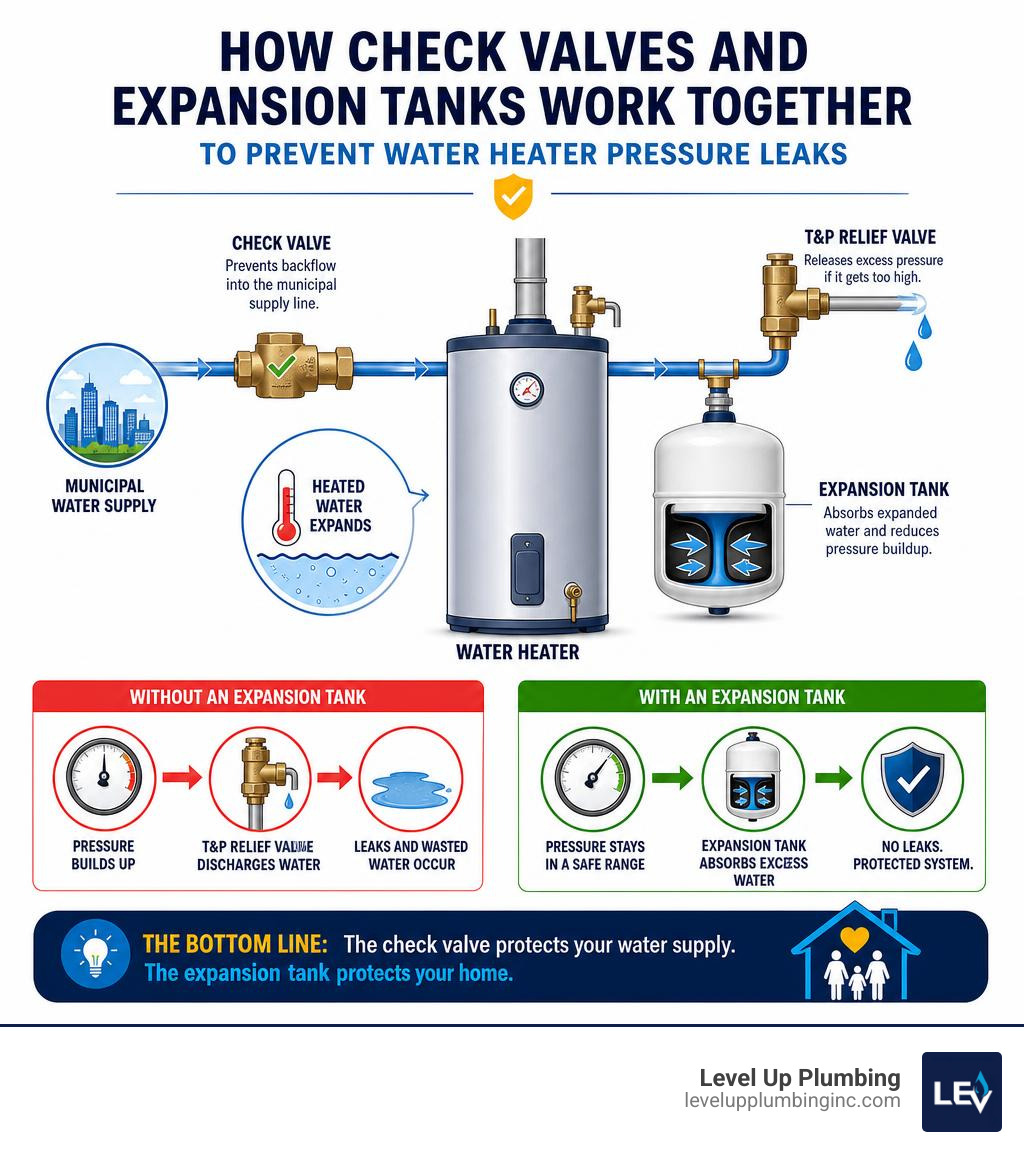
- Check valves stop water from flowing backward into the municipal supply line
- When a check valve creates a closed plumbing system, heated water has nowhere to expand, which can cause pressure spikes
- Pressure spikes force the T&P relief valve to drip or discharge water
- The fix usually involves inspecting the check valve, testing the expansion tank, and flushing the system
- Annual professional service prevents most check valve-related leaks before they start
That drip coming from your water heater isn’t always a sign the whole unit needs replacing. In many Orange County homes, the real culprit is something much smaller: a check valve that has created a closed plumbing system with nowhere for expanding water to go.
When your water heater heats a tank of water, that water expands in volume. In an open plumbing system, the extra pressure bleeds back into the municipal supply line. That is usually not a problem. But if your home has a pressure reducing valve, a backflow preventer, or a check valve on the main line, that pressure has nowhere to escape. It builds up quickly.
Without a working expansion tank to absorb that pressure, the T&P (temperature and pressure) relief valve kicks in and releases water as a safety measure. Many homeowners mistake this for a T&P valve failure. Often, the root cause is the check valve and a failed or missing expansion tank.
Orange County’s moderately hard water, which runs between 10 and 25 grains per gallon depending on your city, makes this worse over time. Mineral deposits can clog or damage check valves, reducing their effectiveness and shortening the life of your entire water heater system.
The good news: most check valve problems are fixable without replacing your water heater.
Understanding Your Water Heater Check Valve and Closed Plumbing Systems
To understand why your water heater is acting up, we need to look at how water enters and moves through your home. Your municipal water supply delivers water under pressure from the city mains directly into your home’s plumbing.
While this pressure is necessary to get a strong stream of water in your second-floor shower, municipal pressure can sometimes exceed safe residential limits, often spiking past 100 or even 200 PSI. To protect your home’s pipes and appliances, local codes require safety devices like backflow preventers and pressure reducing valves.
While these devices do an excellent job of protecting the city’s clean water supply and your home’s pipes, they also create a “closed plumbing system.” In a closed system, water can flow in, but it cannot flow backward. This is where the check valve comes into play, acting as a strict one-way street on your cold water line. To learn more about how these safety features protect your home, check out our guide on Expert Water Heater Safety and Pressure Control.

What is a Check Valve and How Does It Differ from a PRV?
It is common to confuse the various valves sitting on or near your water heater. Each serves a very distinct purpose:
- Check Valve (or Backflow Preventer): This is a mechanical device designed to enforce a strict one-way flow. It allows cold water to flow into your water heater but prevents hot water, or any water from inside your home, from backing up into the cold water supply lines.
- Pressure Reducing Valve (PRV): A PRV is designed to manage high incoming water pressure from the municipal main. It dials down the water pressure to a safe residential level, typically between 50 and 75 PSI. If your home’s water pressure exceeds the critical 80 PSI threshold, you run a high risk of pipe bursts, appliance damage, and slab leaks.
If you are curious about how these valves connect to your overall system, you can read More info about connecting water heaters.
Open vs. Closed Systems: How to Tell What Your Home Has
An open plumbing system allows water to expand backward into the public water main when pressure builds up. A closed plumbing system prevents this backward movement because of a check valve, backflow preventer, or PRV installed near your water meter or main water line entry point.
Most homes built in Orange County since the 1990s are closed systems. Here is a quick breakdown to help you compare the two:
| Feature | Open Plumbing System | Closed Plumbing System |
|---|---|---|
| Backflow Prevention | None installed on the main line | Check valve, PRV, or backflow preventer present |
| Where Expanded Water Goes | Pushed back into the municipal water main | Trapped inside your home’s plumbing system |
| Pressure Build-Up | Minimal pressure spikes | High pressure spikes, also called “pressure stacking,” during heating |
| Expansion Tank Required? | No | Yes, mandated by California Plumbing Code |
| Risk of T&P Valve Leaks | Low | High if the expansion tank fails or is missing |
The Role of Thermal Expansion Tanks and T&P Relief Valves
When a 50-gallon water heater heats a full tank of cold water, that water expands, creating roughly an extra half-gallon of water volume. In a closed system, because the check valve prevents that extra volume from escaping, the water pressure can instantly spike from a normal 60 PSI to over 150 PSI.
To manage this, we rely on two key safety devices:
- The Thermal Expansion Tank: This is a small steel tank, usually 2 to 4.5 gallons, installed on the cold water line above the water heater. Inside, a flexible rubber diaphragm separates an air chamber from the water. When water expands, it pushes against the diaphragm, compressing the air and safely absorbing the excess pressure.
- The T&P (Temperature and Pressure) Relief Valve: This is your water heater’s ultimate safety net. If pressure spikes to 150 PSI or the temperature reaches 210°F, this valve opens to discharge water and prevent the tank from rupturing.
If your expansion tank’s rubber diaphragm wears out or becomes waterlogged, those pressure spikes have nowhere to go, forcing the T&P valve to drip continuously. Keeping these components in check is why routine care is so vital. Read more about this in The Importance of Annual Maintenance to Your Water Heater.
4 Easy Ways to Stop and Prevent Water Heater Check Valve Leaks
If you have noticed water pooling around your water heater or a persistent drip from your discharge pipe, don’t panic. Here are four practical ways to resolve and prevent check valve and pressure leaks in your home.
Why You Need Routine Water Heater Check Valve Service Orange County
The absolute best way to handle a leak is to prevent it from happening in the first place. Over time, the internal seals, springs, or flaps inside a check valve can wear down, stick, or become coated in mineral scale.
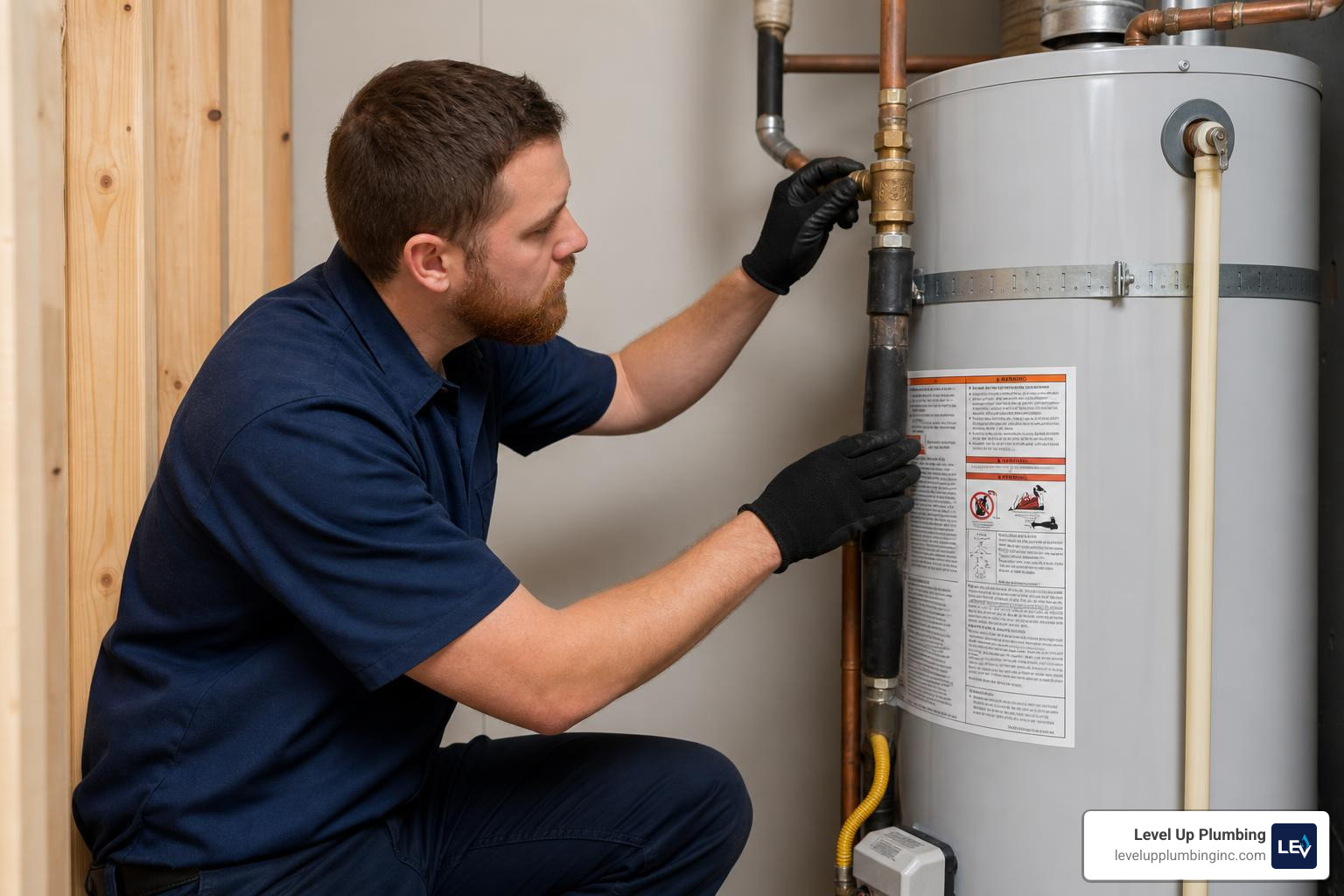
By scheduling a regular water heater check valve service in Orange County, you ensure that a professional plumber inspects your valves, tests system pressure, and identifies minor issues before they turn into costly emergencies. If you want to keep your hot water flowing reliably, check out our guide on how to Stop Running Out of Hot Water with Level Up Plumbing.
How to Identify and Replace a Failed Thermal Expansion Tank
When a check valve is working correctly, it forces your thermal expansion tank to do some heavy lifting. Unfortunately, expansion tanks only last about 5 to 8 years before their internal rubber diaphragm ruptures. When this happens, the tank fills completely with water, becomes “waterlogged,” and can no longer absorb pressure.
To test your expansion tank:
- Locate the small Schrader valve, which looks exactly like a bicycle tire valve stem, on the top or bottom of the expansion tank.
- Remove the plastic cap and briefly press the tiny pin in the center of the valve.
- Analyze the result: If air hisses out, your tank’s diaphragm is likely still intact. If water sprays out, the diaphragm has ruptured, and the tank is waterlogged.
- Tap the tank with a metal wrench. The top half should sound hollow, while the bottom half should sound dull and full of water. If the entire tank sounds solid, it has failed.
If your tank has failed, it must be replaced to restore pressure relief to your closed system. For expert assistance with this diagnostic and replacement process, explore our Professional Water Heater Repair Services.
Flushing the System to Clear Hard Water Mineral Buildup
Orange County water is notoriously hard. As water is heated, dissolved minerals like calcium and magnesium solidify into scale. This sediment settles at the bottom of tank-type water heaters and can find its way into your valves, causing check valves to stick open or closed.
Flushing your water heater at least once a year removes this sediment, protects your check valves, and keeps your heating elements running efficiently. For more technical details on keeping your heating components clean and functional, refer to The Ultimate Hot Water Heater Element Replacement Guide.
Upgrading to Contractor-Grade Check Valves and Flex Lines
If your check valve is leaking or failing to hold pressure, upgrading to high-quality, contractor-grade components is the smartest move. Many retail-grade valves use plastic internal parts that degrade quickly under constant heat and pressure.
We recommend upgrading to heavy-duty brass check valves and replacing old, rigid copper connections with high-quality, corrugated stainless steel flex lines. These contractor-grade flex lines are much less prone to kinking, cracking, or leaking at the connection joints. If you are weighing your options between different types of systems and upgrades, take a look at our article Exploring the World of Water Heaters.
Professional Water Heater Check Valve Service Orange County: Costs and Codes
Plumbing systems are highly regulated to protect public health and safety. Working on check valves, pressure valves, and water heaters requires a clear understanding of local codes and professional standards.
What is the Cost of Water Heater Check Valve Service Orange County?
The cost of servicing or replacing a check valve and its related components in Orange County depends on several factors:
- The scope of the work: Is it a simple check valve replacement, or do you also need a new thermal expansion tank and a system flush?
- The type of water heater: Servicing valves on a standard gas tank differs from working on complex tankless or recirculating systems.
- Accessibility: Water heaters located in tight attic spaces or crawlspaces may require more labor.
While we avoid quoting fixed prices because every home’s plumbing is unique, we always provide clear, upfront, flat-rate options before starting any work. Whether you need assistance in Huntington Beach, Cypress, Garden Grove, or anywhere else in the region, we provide professional assistance tailored to your specific neighborhood. You can visit our page on Orange County Water Heaters to learn more and schedule an inspection.
Orange County Plumbing Codes and Seismic Strapping Requirements
In California, plumbing codes are strictly enforced to protect homes from seismic activity and high pressure.
- California Plumbing Code Section 608.3: This code mandates that any closed-loop plumbing system, which includes any system with a check valve, backflow preventer, or PRV, must have an approved device to control thermal expansion. This means if you have a check valve, you must have a working expansion tank installed. You can read more about these standards on the California Building Standards Commission website.
- Seismic Strapping: Because Orange County sits near active fault lines, California law requires all water heaters to be securely anchored, braced, or strapped to resist horizontal displacement during an earthquake. This requires two heavy-duty metal straps, one securing the upper third of the tank and one securing the lower third, anchored directly into wall studs.
When we perform a water heater check valve service in Orange County, we don’t just fix the leak. We ensure your entire system is brought up to the latest safety codes. You can learn more about code compliance by visiting Orange County Water Heater Repairs and Replacements.
Frequently Asked Questions About Orange County Check Valves
How do I know if my water heater check valve has failed?
A failed check valve often allows hot water to backflow into your cold water lines, meaning you might feel warm water coming out of your cold faucets. Other signs include vibrating or rattling pipes when the water heater is running, unexplained water temperature fluctuations, or a dripping T&P valve caused by pressure stacking.
Why is water dripping from my temperature and pressure (T&P) relief valve?
Water dripping from your T&P valve is usually a sign of thermal expansion in a closed system. If your check valve is working but your thermal expansion tank has failed, or if you don’t have one, the expanding water has nowhere to go. The pressure spikes, forcing the T&P valve to open slightly and drip to relieve the dangerous pressure.
How often should I have my water heater check valve inspected?
We recommend having your check valve, expansion tank, and water pressure inspected at least once a year during your annual water heater maintenance. Because Orange County’s hard water accelerates mineral scale buildup, annual checks are essential to prevent valves from seizing or leaking prematurely.
Conclusion
A leaking water heater doesn’t have to throw your household into chaos. Often, the solution is as simple as servicing a sticking check valve, replacing a worn-out thermal expansion tank, or clearing away hard water sediment.
At Level Up Plumbing, we are proud to be a woman-owned plumbing company serving Orange County with premier residential plumbing services. With over 21 years of local expertise and award-winning customer service, we make it easy to get your hot water system running safely, efficiently, and completely up to code. Whether you are in Huntington Beach, Cypress, or Garden Grove, we are here to help.
Don’t let a small valve leak turn into a major flood. Schedule professional water heater services today and let our expert team level up your home’s plumbing!