
Why Toilet Problems in Orange County CA Deserve Fast, Expert Attention
If you’re dealing with toilet repair in Orange County, CA, here’s what you need to know right away:
Quick answers for Orange County homeowners:
- Running toilet? Usually a worn flapper, faulty fill valve, or misadjusted float — a plumber can fix it fast
- Clogged toilet? Hard water and low-flow toilets make clogs more common in Southern California — professional clearing may be needed
- Leaking at the base? This points to a failed wax ring or loose flange — don’t wait, it causes floor damage
- Weak flush? Mineral buildup from hard water narrows internal passageways over time
- Cracked bowl or frequent repairs? It may be time to replace rather than repair
Toilet problems are one of the most common plumbing headaches for homeowners in Southern California. Over 60% of homeowners in the region experience at least one toilet-related issue per year. And in Orange County specifically, factors like hard water mineral buildup and aging low-flow toilets add extra stress to an already well-used fixture.
A malfunctioning toilet isn’t just inconvenient. Left unaddressed, it can mean wasted water, rising utility bills, and real damage to your floors and subfloor. A running toilet alone can waste hundreds of gallons every single day.
The good news? Most toilet problems are fixable — often quickly — when you work with a licensed local plumber who knows Orange County’s water conditions and plumbing standards.
Level Up Plumbing is here to help you understand what’s wrong, what your options are, and how to get it resolved without the runaround.
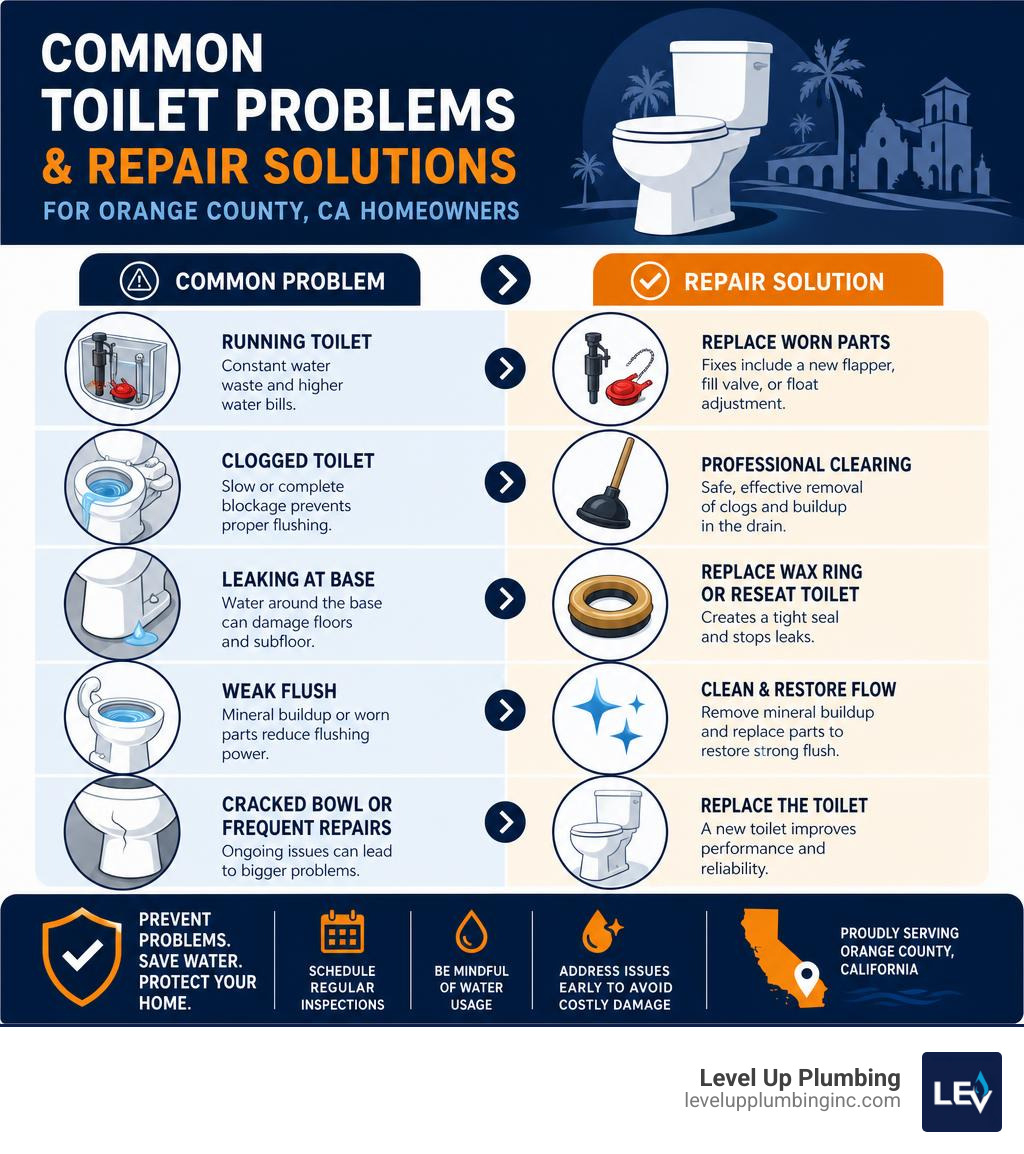
Common Toilet Problems Requiring Toilet Repair in Orange County CA

When it comes to toilet repair in Orange County, CA, understanding what is happening inside the tank and bowl is the first step toward a permanent fix. Toilets are relatively simple machines, but when one component fails, it can disrupt your entire household routine.
Here are the most frequent issues we encounter in local homes:
Clogged Toilet
A clogged toilet is an immediate household emergency. While a simple plunger can clear minor blockages, recurring clogs often point to deeper issues. In Southern California, clogs are frequently caused by flushing non-flushable items, excessive toilet paper use, or structural issues within the drain line itself.
Running Toilet
If you hear water constantly trickling or hissing from your bathroom long after you have flushed, you have a running toilet. This is more than just an annoying background noise; it is a direct drain on your wallet. A running toilet can waste hundreds of gallons of water daily, silently inflating your local utility bills.
Leaking Base
Water pooling around the bottom of your toilet is a serious warning sign. This usually indicates that the wax ring sealing the toilet to the floor has degraded, or the toilet flange has become loose or broken. Because this water is unsanitary and can quickly rot your bathroom’s subfloor, a leaking base requires immediate professional attention.
Weak Flush
If your toilet requires multiple flushes to clear waste, or if the water in the bowl merely swirls without draining forcefully, you are dealing with a weak flush. This is incredibly common in older low-flow models and homes with significant mineral scaling.
Mineral Buildup and Hard Water
Southern California is notorious for its hard water. The water supply carries high levels of calcium and magnesium, which leave behind white, chalky mineral scale. Over time, this mineral buildup calcifies inside your toilet’s siphon jets, rim holes, and trapway. As these pathways narrow, the toilet loses its flushing power, leading to persistent clogs and poor performance.
Troubleshooting a Running Toilet and When to Seek Toilet Repair in Orange County CA
A running toilet is usually caused by a failure in one of three main internal components:
- The Flapper Valve: This rubber seal sits at the bottom of the tank. Over time, chlorine and minerals in the water cause the rubber to warp, crack, or rot, allowing water to constantly leak from the tank into the bowl.
- The Fill Valve: This component controls the water entering the tank. If it becomes worn or clogged with sediment, it may fail to shut off properly.
- The Float Ball or Float Cup: If the float is set too high or is physically damaged, the water level in the tank will rise above the overflow tube, causing water to run continuously.
While a handy homeowner might attempt to adjust the float or swap out a basic flapper, a constantly running toilet can sometimes stem from high city water pressure or deeper mechanical failures. If you have replaced the flapper and your toilet still runs, it is time to call in the experts. For more details on how we can restore your bathroom’s efficiency, check out More info about our plumbing services.
Dealing with Stubborn Clogs and Hard Water in Orange County CA
Low-flow toilets introduced in the mid-to-late 1990s were designed to save water, but early models often lacked the structural engineering to flush effectively with lower water volumes. Combined with the S-trap design—which naturally keeps sewer gases out but is highly susceptible to catching physical obstructions—these fixtures are prime targets for stubborn clogs.
Furthermore, many households fall victim to the myth of “flushable” wipes. Despite what the packaging claims, these wipes do not break down in water like standard toilet paper. Instead, they catch on rough cast iron pipes or mineral scale deposits, creating massive blockages deep within your drain lines.
If you are dealing with persistent clogs that a plunger cannot resolve, you may need professional drain clearing or advanced hydrojetting to scour the mineral scale and debris from your pipes. If you are experiencing these issues in Cypress, you can seek reliable plumbing assistance to clear the lines. To learn how our team clears even the toughest blockages, explore Our professional drain cleaning services.
Toilet Repair vs. Replacement: How to Decide
Deciding whether to repair your existing toilet or replace it entirely comes down to a few key factors: the age of the fixture, the frequency of repairs, and the structural integrity of the porcelain.
| Factor | Consider Repair | Consider Replacement |
|---|---|---|
| Porcelain Condition | Superficial stains or minor scratches | Visible hairline cracks in the tank or bowl |
| Stability | Needs minor bolt tightening or a new wax ring | Wobbles due to rotted subflooring or cracked porcelain base |
| Frequency of Issues | One-off clog or a simple flapper replacement | Constant clogs, leaks, and recurring part failures |
| Water Efficiency | Modern model (1.28 to 1.6 GPF) | Older model (3 to 7 GPF) wasting water |
| Repair Cost vs. New Unit | Minor component replacement is highly cost-effective | Multiple repairs cost nearly as much as a brand-new unit |
Porcelain Cracks
Porcelain is incredibly durable, but once it develops a hairline crack, it cannot be reliably repaired. A cracked tank or bowl can burst unexpectedly under water pressure, leading to catastrophic flooding in your home. If you spot any cracks in the porcelain, replacement is your only safe option.
Wobbling Base
A toilet should sit firmly on the floor. If it rocks or wobbles when you sit on it, the issue could be a loose flange, a broken bolt, or—more seriously—rotted wood in the subfloor underneath. If the floor is soft, the entire toilet and surrounding flooring will need to be removed to repair the structural damage before a new toilet can be safely installed.
Toilet Age and Water Efficiency
Toilets manufactured before 1994 can use anywhere from 3 to 7 gallons of water per flush (GPF). Modern high-efficiency toilets use just 1.28 GPF or less. Upgrading an ancient, water-guzzling toilet to a modern fixture is one of the easiest ways to permanently lower your monthly water bills.
When to Choose Professional Toilet Repair in Orange County CA
Many minor toilet issues can be solved with a quick repair. If your toilet is structurally sound but has a failed wax ring, a broken flange, or minor internal leaks, professional repair is highly cost-effective. Replacing a wax ring and resetting the toilet can breathe years of new life into an otherwise perfect fixture.
When you need reliable, long-lasting repairs, working with a highly rated local plumber ensures the job is done right the first time. For those located in coastal areas, you can find trusted local toilet installation services or secure fast help to address sudden leaks. To get hands-on assistance from our experienced team, visit our Expert toilet services in Huntington Beach and Orange County page.
Benefits of Upgrading to Modern Low-Flow Toilets
If you decide that replacement is the smarter path, upgrading to a modern low-flow or dual-flush toilet offers outstanding long-term benefits:
- Water Conservation: You will save thousands of gallons of water per year, which is crucial for our Southern California environment.
- Compliance with California Regulations: State laws require high-efficiency fixtures, and upgrading ensures your home meets current building standards.
- Superior Flushing Technology: Modern toilets feature redesigned trapways and powerful siphon jets that resist mineral buildup and prevent clogs far better than older models.
- Dual-Flush Options: These models allow you to choose between a partial flush for liquids and a full flush for solids, maximizing your daily water savings.
Local Regulations and Professional Standards in Southern California
Plumbing in Southern California is subject to strict standards designed to protect homeowners and conserve precious water resources. Under current California building codes, any new toilet installed must be a high-efficiency model that uses no more than 1.28 gallons per flush.
In some municipalities, replacing a plumbing fixture may require a simple plumbing permit to ensure the work is completed up to code. Working with a licensed and bonded plumbing company like Level Up Plumbing helps ensure that all work complies with local city ordinances. Additionally, many local water districts in Orange County offer rebates to homeowners who replace old, water-wasting toilets with certified high-efficiency models. You can also learn more about efficient toilet standards through the U.S. Environmental Protection Agency’s WaterSense labeled toilets resource.
By hiring a professional, you ensure your new installation is fully compliant, leak-free, and eligible for any active local rebates.
Frequently Asked Questions about Toilet Plumbing
Navigating toilet repairs can bring up plenty of questions. Below, we address some of the most common concerns we hear from homeowners across Orange County.
How much does toilet repair cost in Orange County?
The final cost of a toilet repair depends entirely on the complexity of the problem. Simple fixes, such as replacing a worn flapper, adjusting a float, or clearing a minor clog, are highly affordable. More extensive repairs—such as replacing a broken closet flange, installing a new wax ring, or repairing water damage to the subfloor—require more labor and materials, which naturally increases the cost.
At Level Up Plumbing, we believe in transparent, flat-rate pricing. We provide clear, upfront estimates before any work begins, so you never have to worry about hidden fees or surprise charges.
How long does a professional toilet repair or installation take?
A standard, straightforward toilet repair—such as replacing internal tank components or clearing a moderate clog—typically takes between 30 minutes and an hour.
If you are replacing your toilet, a professional installation usually takes between 1 and 2 hours. This process includes turning off the water supply, draining and removing the old toilet, inspecting the existing flange and floor condition, setting a fresh wax ring, leveling the new toilet, connecting the water lines, and performing multiple test flushes to verify a flawless seal.
Can I perform toilet repairs myself or should I hire a professional?
While handy homeowners can easily handle basic tasks like replacing a tank handle or adjusting a lift chain, more complex repairs are best left to licensed professionals.
Improper DIY toilet installation or repair carries significant risks. A poorly sealed wax ring can leak slowly and silently beneath the toilet base, rotting out your bathroom floor before you ever notice a puddle. Furthermore, over-tightening the bolts that secure the toilet to the floor or tank can easily crack the fragile porcelain, instantly ruining a brand-new fixture.
Hiring a professional plumber gives you access to specialized diagnostic tools, ensures compliance with local plumbing codes, and provides peace-of-mind warranty support for both parts and workmanship. If you are located in the northern part of the county, you can easily find trusted professional fixture replacement and drain services to ensure your bathroom plumbing is handled safely.
Conclusion
A malfunctioning toilet can quickly disrupt your home’s comfort and waste precious water resources. Whether you are dealing with a silent, water-wasting run, a stubborn clog caused by hard water, or a damaged wax ring, getting professional help is the fastest way to restore your peace of mind.
Level Up Plumbing is a proud, woman-owned plumbing company serving homeowners throughout Orange County, including Cypress, Garden Grove, and Huntington Beach. With more than 21 years of local expertise and award-winning customer service, we treat your home with the care and respect it deserves. We are committed to providing honest advice, transparent pricing, and exceptional workmanship on every single job.
Don’t let a minor plumbing issue turn into a costly water damage repair. Schedule your toilet repair in Orange County with the trusted team at Level Up Plumbing today!