
Why Your Hot Water Heater Mixing Valve Adjustment Matters
A proper hot water heater mixing valve adjustment is the fastest way to fix water that’s too hot, too cold, or inconsistent at your taps. Here’s how to do it in 5 steps:
- Run hot water at a nearby faucet for 2 minutes
- Locate the mixing valve near your water heater on the hot water outlet
- Remove the protective cap to expose the adjustment dial or Allen key slot
- Turn the dial in small increments (1/8 to 1/4 turn) — left for hotter, right for cooler
- Measure the outlet temperature on the pipe (not the faucet) and aim for 120°F
If your shower swings between scalding and freezing, or your hot water runs out too fast, your mixing valve is likely the culprit — not the water heater itself.
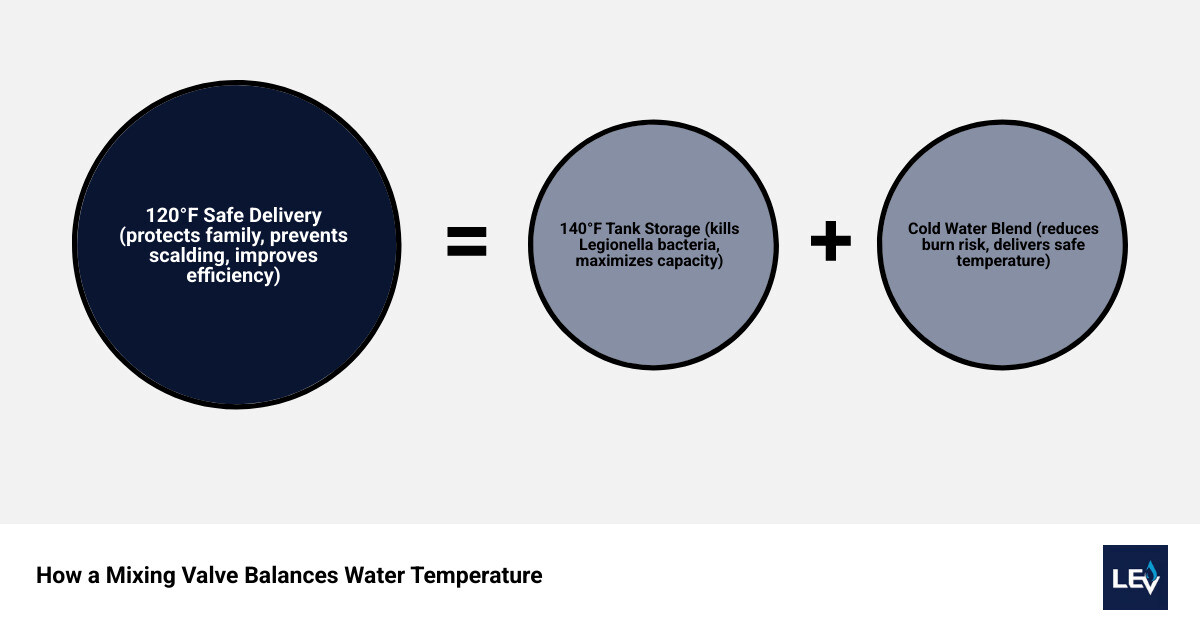
Here’s why this matters: water stored at 140°F kills dangerous bacteria like Legionella, but that same water can cause a serious burn in under 5 seconds. A thermostatic mixing valve (TMV) sits between your tank and your taps, blending in cold water so you get a safe 120°F at the faucet — without sacrificing tank capacity or safety.
Getting this balance right protects your family and can even stretch your hot water supply by up to 25%.
The Science of Water Temperature: Safety vs. Capacity
Understanding the relationship between tank storage temperatures and fixture delivery temperatures is essential for maintaining a safe, comfortable home. Many homeowners in Orange County, CA, wonder why they can’t simply turn down their water heater’s thermostat to 120°F and call it a day. While that seems like an easy fix, it introduces a whole new set of biological and operational problems.
By utilizing a thermostatic mixing valve, you can separate your storage temperature from your delivery temperature. This simple separation is a game-changer for your household’s daily comfort and safety. If you find your family constantly fighting over who gets to shower first, you might need to look at how your system manages this delicate balance. You can read more about how to resolve these issues in our guide on how to Stop Running Out of Hot Water with Level Up Plumbing.

Scalding Risks and Point-of-Use Safety
The primary job of a mixing valve is anti-scald protection. Water temperatures that feel perfectly fine for washing dishes can be incredibly dangerous, especially for children, the elderly, or pets whose skin is much thinner and more sensitive.
To put the danger into perspective, let’s look at how quickly human skin burns at different temperatures:
| Water Temperature | Time to Receive a Serious (Third-Degree) Burn |
|---|---|
| 160°F | 1/2 second |
| 150°F | About 1.5 seconds |
| 140°F | Less than 5 seconds |
| 133°F | About 15 seconds |
| 127°F | About 1 minute |
| 124°F | 3 to 4 minutes |
| 120°F | More than 5 minutes |
The Environmental Protection Agency (EPA) recommends that households set their hot water delivery to 120°F. At this level, the risk of accidental scalding is dramatically reduced, giving you more than five minutes to react before a serious burn occurs. This is why a calibrated mixing valve is so vital: it ensures that even if your tank is sizzling hot, the water coming out of your showerhead or kitchen faucet remains at a safe, predictable temperature.
Legionella Prevention and Tank Capacity
So, why not just set the actual water heater thermostat to 120°F? The answer lies in microscopic pathogens—specifically Legionella bacteria, which causes Legionnaires’ disease (a severe form of pneumonia). Legionella thrives in warm water environments, particularly between 77°F and 113°F.
To completely neutralize and kill these bacteria, water must be stored at a minimum of 140°F. Storing water at this high temperature acts as a continuous thermal disinfection cycle.
Beyond health concerns, keeping your tank at 140°F dramatically increases your home’s usable hot water capacity. When you store water at 140°F and use a mixing valve to blend it down to 120°F at the outlet, you use less water from the tank for every gallon of warm water delivered to your fixtures. In fact, setting your tank to 140°F and mixing it down can stretch your hot water supply by up to 25% to 50%. This is like turning your 50-gallon tank into a virtual 75-gallon powerhouse without taking up any extra space in your garage or closet! For a deeper dive into how this thermodynamic trick works, check out this guide on How a Mixing Valve Can Get More Out of Your Water Heater – Rheem.
Why a Hot Water Heater Mixing Valve Adjustment is Essential
Leaving your mixing valve uncalibrated or failing to adjust it over time can lead to energy waste, poor system performance, and unexpected cold shocks in the shower. Over months and years, the internal components of a mixing valve can drift, or local water quality can cause mineral scaling that restricts the valve’s movement. Regular calibration and testing should be a standard part of your home care routine. Learn more about protecting your system with The Importance of Annual Maintenance to Your Water Heater.
Optimizing Heat Pump Water Heaters
If you have upgraded to a modern, energy-efficient heat pump (hybrid) water heater, managing your mixing valve is even more critical. Heat pump water heaters are incredibly efficient because they pull heat from the surrounding air to warm your water. However, they operate most efficiently when the temperature differential—the gap between the incoming cold water and the target tank temperature—is smaller.
If you set your heat pump water heater to an extremely high temperature (like 150°F) just to get more capacity, the unit may frequently turn off its highly efficient compressor and engage its energy-hogging backup electrical resistance elements.
To maximize your savings:
- Set your heat pump water heater tank temperature to 130°F or 140°F (to keep it operating primarily in its high-efficiency hybrid or heat-pump-only mode).
- Calibrate your mixing valve to deliver 115°F to 120°F to your home.
This sweet spot prevents the backup resistance elements from firing up unnecessarily while still keeping your hot water clean, safe, and plentiful. For a technical breakdown of this balance, read through this community discussion on How to set temperature and mixing valve for heat pump water heater?.
Managing Recirculating Hot Water Systems
Many homes in Cypress, CA, and Huntington Beach, CA, use hot water recirculating loops to get instant hot water at distant faucets. If you have a recirculation system, your mixing valve must be piped and adjusted correctly to prevent “thermal creep”—a phenomenon where the water in the loop slowly heats up to the tank’s high storage temperature overnight when no water is being used.
In a recirculating system, the return line should be piped back into the cold water inlet of the mixing valve using a dedicated bypass loop, complete with check valves and a balancing valve. When adjusting a thermostatic mixing valve in a system with a recirculation loop (such as those using the Taco 5000-3 Series Lead Free Mixing Valve), you must adjust the system’s balancing valves to ensure that the returning water doesn’t disrupt the valve’s internal thermal sensor.
How to Perform a Hot Water Heater Mixing Valve Adjustment
Adjusting your mixing valve is a straightforward task, but it requires patience and precision. Because you are dealing with hot water that can cause instant burns, always wear protective gloves and safety glasses.
Tools Required for Hot Water Heater Mixing Valve Adjustment
Before you begin, gather the following tools:
- An accurate thermometer: A digital kitchen thermometer, a clamp-on pipe thermometer, or an infrared thermocouple thermometer.
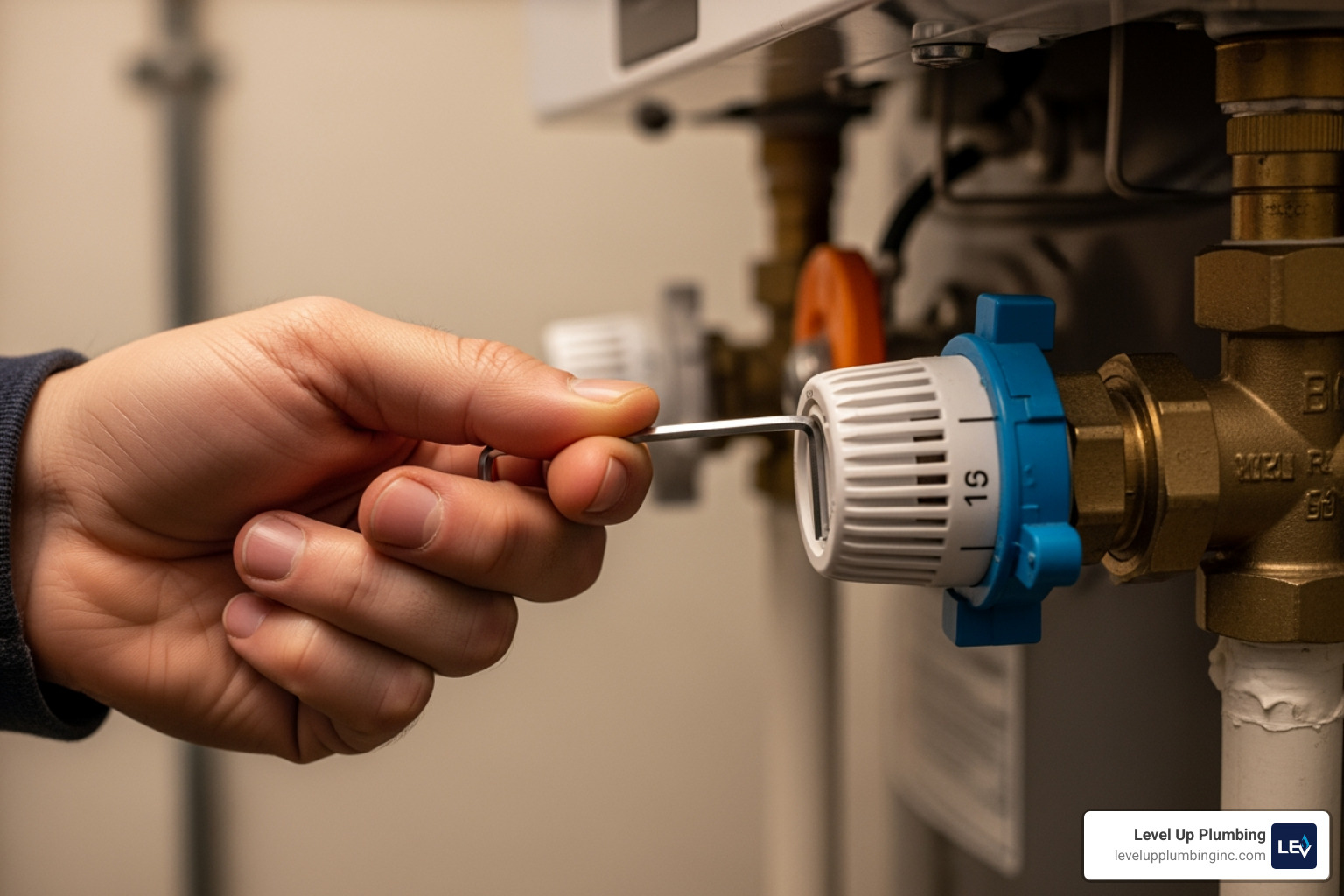
- An Allen wrench (hex key) or flathead screwdriver: Depending on your valve model (many Cash Acme, Taco, and Leonard valves use an Allen key or a small dial under the cap).
- A small flathead screwdriver: To pry off the protective plastic cap.
- Safety gloves: To protect your hands from hot pipes.
The 5-Step Adjustment Process
Follow these steps to calibrate your mixing valve perfectly:
Step 1: Run Hot Water to Stabilize the System
Go to the nearest non-aerated fixture (like a bathtub faucet) and turn the hot water on fully. Let it run for at least 2 minutes. This flushes out any cold water sitting in the pipes and ensures that the mixing valve is actively blending hot water from the tank with incoming cold water.
Step 2: Locate the Valve and Remove the Cap
Head over to your water heater. The mixing valve is typically installed directly on top of the tank, connected to the hot water outlet pipe, with a tee-connection running over to the cold water supply line. Use a small screwdriver to gently pop off the plastic protective cap (often green, blue, or black) on top of the valve.
Step 3: Identify the Adjustment Mechanism
Look inside the top of the valve.
- Some models, like the Model 310 Thermostatic Mixing Valve, feature a set screw marked “WARMER” and “COOLER”.
- Other models, like the Taco 5000-3 Series Lead Free Mixing Valve, require you to use an inset tool or dial.
- High-low commercial-grade valves, such as the XL-150R34 [Compatibility Mode] or other Leonard TM models, might require loosening a locking LTR set screw before you can turn the pointer.
Step 4: Make Small, Incremental Adjustments
Using your Allen wrench or screwdriver, turn the adjustment screw in small increments—no more than 1/8 to 1/4 of a turn at a time.
- Turn Counter-Clockwise (Left): Increases the temperature (allows more tank hot water through).
- Turn Clockwise (Right): Decreases the temperature (blends in more cold water).
After making a small turn, wait 1 minute for the water temperature to stabilize inside the valve body.
Step 5: Measure the Pipe Temperature and Lock It In
Do not rely on the temperature at the kitchen sink faucet to calibrate the valve, as heat loss through the pipes or built-in faucet anti-scald devices can give you a false reading. Instead, use a clamp-on thermometer or an infrared thermocouple directly on the copper pipe coming out of the “MIX” port of the valve.
Aim for an outlet temperature of 120°F. Once you reach this target, tighten any locking screws (if your model has them), snap the protective plastic cap back on to prevent accidental tampering, and shut off the running faucet.
Note: If your valve’s incoming hot water exceeds 150°F, you may need to reset the valve’s high-temperature limit stop manually to ensure it cannot be turned past 120°F. For detailed instructions on setting limit stops, refer to the INSTALLATION ADJUSTMENT SERVICE manual or the Kohler TMV specifications in the No Job Name guide.
Troubleshooting and Maintaining Your Mixing Valve
Thermostatic mixing valves are highly reliable, but they are not set-it-and-forget-it devices. Because they sit at the crossroads of your hot and cold water streams, they are highly susceptible to mineral scaling, sediment buildup, and mechanical wear.
Signs Your Valve Needs Repair or Replacement
If you notice any of the following warning signs, your mixing valve likely needs to be cleaned, repaired, or replaced:
- Inconsistent Water Temperatures: If your shower starts warm but suddenly drops to cold within seconds, the internal thermal element (the wax cartridge or spring) may be failing to expand and contract properly. This is a common issue in RVs and homes alike, often resolved by cleaning or replacing the cartridge.
- Weak Hot Water Flow: If you have great cold water pressure but your hot water flow is a mere trickle, the inlet strainers on the hot side of your mixing valve may be clogged with sediment or calcium scale.
- Water is Way Too Hot or Cold: If adjusting the dial does absolutely nothing to change the temperature at your taps, the internal piston may be seized. Hard water minerals can lock the piston in place, preventing it from blending the water.
- Drips and Leaks: Any visible water dripping from the adjustment cap or the union joints indicates that the internal O-rings have degraded and need replacement.
If you are experiencing any of these issues and live in our local service area, you can easily find trusted professional help. Check out the top-rated local plumbing experts listed on Top 10 Best Water Heater Installation/Repair Near Orange County … or reach out to our team at Level Up Plumbing for fast, friendly service.
Frequently Asked Questions
What is the ideal temperature setting for a mixing valve?
For safety, comfort, and energy efficiency, the ideal temperature setting for a residential mixing valve output is 120°F (49°C). This is warm enough for comfortable showers and effective dishwashing, yet safe enough to prevent rapid scalding.
How do I adjust a valve without a built-in thermometer?
If your mixing valve does not have an integrated temperature gauge, you can easily verify the temperature using a digital pocket thermometer or an infrared temperature gun. Run a nearby hot water tap for two minutes, and hold the thermometer under the stream of water, or clamp a digital probe directly onto the hot water outlet pipe coming out of the mixing valve.
Can a mixing valve fail?
Yes, mixing valves can fail over time. The most common causes of failure are mineral scale buildup from hard water, which can seize the internal moving parts, and the natural degradation of the internal thermostatic wax element. Regular annual flushing and cleaning of the valve’s internal strainers can significantly extend its lifespan.
Conclusion
A properly executed hot water heater mixing valve adjustment is one of the simplest ways to protect your family from painful scalds while maximizing your home’s hot water supply. By keeping your water heater tank at a safe 140°F to eliminate bacteria and using a calibrated mixing valve to deliver 120°F to your taps, you get the absolute best of both worlds: safety and abundance.
While adjusting a mixing valve is a manageable DIY project for many homeowners, plumbing systems can sometimes be tricky—especially when dealing with recirculating loops, older copper piping, or seized valves.
If you live in Cypress, CA, Huntington Beach, CA, or Garden Grove, CA, and would rather leave it to the professionals, our team at Level Up Plumbing is here to help. As a proud woman-owned plumbing company with over 21 years of local expertise in Orange County, we pride ourselves on award-winning customer service and top-tier craftsmanship.
Whether you need a quick valve adjustment, a complete system flush, or a brand-new water heater installation, we’ve got you covered. Check out our comprehensive services on our Water Heaters page, or explore your options in our detailed guide, Water Heaters: Which is Best for Me?.
Ready to level up your home’s comfort? Give us a call today, and let’s get your hot water running perfectly!